Fear Your Strengths: What You Are Best at Could Be Your Biggest Problem by Robert E. Kaplan & Robert B. Kaiser
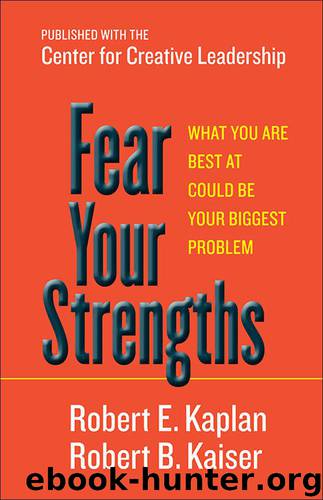
Author:Robert E. Kaplan & Robert B. Kaiser [Kaplan, Robert E.]
Language: eng
Format: mobi
Publisher: Berrett-Koehler Publishers
Published: 2013-03-31T14:00:00+00:00
Two years later, he had made progress that was clearly reflected in the high praise that his team and the board heaped on him in the follow-up report. In a kind of graduation ceremony he took out his original list and hand-entered “smart.” Although his sense of self-worth remained a work in progress, thereafter, when he tackled strategic issues and began to doubt his ability to handle them, he was able to catch himself, banish the thought, and get down to work.
Leaders often have trouble backing off an overused behavior because they see it as an all-or-nothing choice. “If I stop being so forceful, will I lose my edge?” “If I stop being so nice to people, will I turn into an SOB?” Faced with feedback that indicated she needed to dial back her tendency to dominate people and situations, Carla Middleton reacted this way: “When I first got the feedback, I took it to mean that I needed to throw an on-off switch. But now I see there are more than two levels. It’s more like a volume control. It’s continuous.” The idea of a dial frees you to fine-tune your strength without any danger of losing it completely. One leader captured the dynamic well: “At the start of the process I worried that the good part would weaken. But no, only the bad part weakens and the good part strengthens.” Truth is, most people could not lose the positive aspects of their strength even if they tried to.
Reining in an excessively used strength doesn’t mean you forsake it. You just learn to be selective with it. The “fastball-throwing” leader, a baseball fan, told us the story of Sandy Koufax, the brilliant Los Angeles Dodgers pitcher who didn’t become great until he stopped throwing his fastball so hard and so often. Koufax came into his own when he took his catcher’s advice to “stop trying to blow the ball by the hitters,” to “try more curves and change-ups.” The Dodgers’ manager, Walter Alston, said that Koufax was less effective when he pitched with “all muscle and no finesse, trying to use 100 percent of his strength.” Once Koufax learned to govern his power, using “90 percent of it in a steady, rhythmical pattern,” and throwing the right pitch in the right situation, he was able to pitch no-hitters in four consecutive seasons culminating with a perfect game in 1965.
Another of the main driving forces behind overuse is perfectionism, a common affliction of leaders. The best becomes the enemy of the good. Psychoanalytic thinker Karen Horney spoke of this as the “tyranny of the shoulds.” Rigidly high expectations and fear of falling short can bully a person into a lack of modulation, which ultimately can be self-defeating.
Andre Agassi, the eight-time Grand Slam tennis champion, revealed in his recent autobiography that he had always hated tennis during his career because of the constant pressure it exerted on him. His friend and later coach, Brad Gilbert, told him: “You don’t have to be the best in the world every time you go out there.
Download
This site does not store any files on its server. We only index and link to content provided by other sites. Please contact the content providers to delete copyright contents if any and email us, we'll remove relevant links or contents immediately.
Hit Refresh by Satya Nadella(9110)
The Compound Effect by Darren Hardy(8912)
Change Your Questions, Change Your Life by Marilee Adams(7724)
Nudge - Improving Decisions about Health, Wealth, and Happiness by Thaler Sunstein(7684)
The Black Swan by Nassim Nicholas Taleb(7092)
Deep Work by Cal Newport(7047)
Rich Dad Poor Dad by Robert T. Kiyosaki(6583)
Daring Greatly by Brene Brown(6493)
Principles: Life and Work by Ray Dalio(6391)
Playing to Win_ How Strategy Really Works by A.G. Lafley & Roger L. Martin(6192)
Man-made Catastrophes and Risk Information Concealment by Dmitry Chernov & Didier Sornette(5987)
Digital Minimalism by Cal Newport;(5742)
Big Magic: Creative Living Beyond Fear by Elizabeth Gilbert(5731)
The Myth of the Strong Leader by Archie Brown(5484)
The Slight Edge by Jeff Olson(5401)
Discipline Equals Freedom by Jocko Willink(5365)
The Motivation Myth by Jeff Haden(5196)
The Laws of Human Nature by Robert Greene(5144)
Stone's Rules by Roger Stone(5068)
